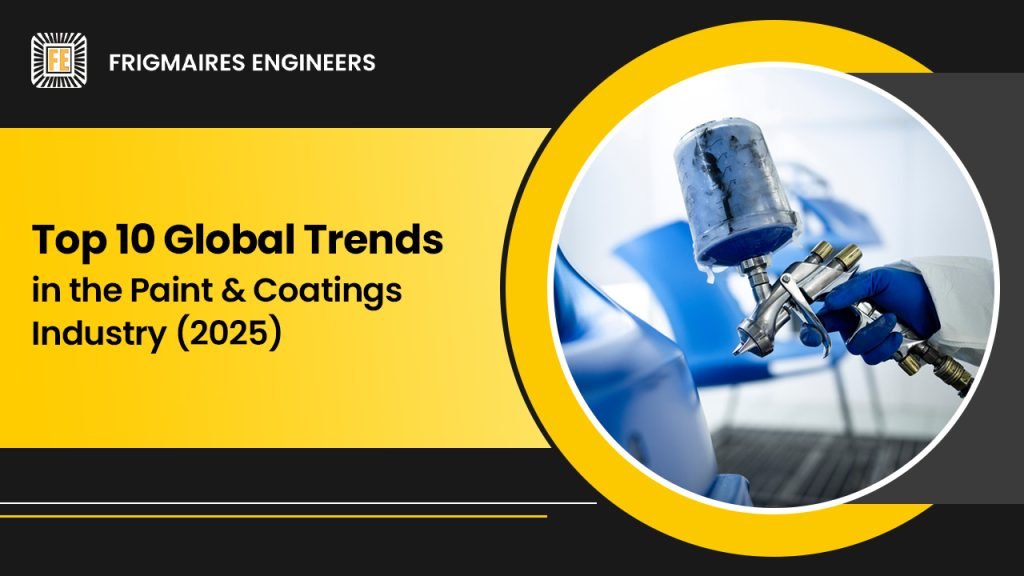
The paint and coating industry has shown a tremendous shift in its products and processes becoming sustainable, eco-friendly, with enhanced performance and efficiency. The emerging trends and innovations in the paint industry have come up with eco-conscious formulations and advanced application methods. The industry is not going to stop here as it is surely going to witness advancements. Here are the top ten trends shaping paint and coatings in 2025, and what they mean for your plant, your products, and your margins.
1) The sustainability pivot goes mainstream
Most buyers now ask for low-VOC, waterborne, or high-solids systems as a baseline, not a bonus. Regulators across North America and Europe keep pushing VOC limits down, which nudges adoption even faster. If you sell into public projects in the USA, UK, or Germany, this shift directly affects specs.
2) Powder coatings keep gaining ground
Powder delivers durable films with near-zero solvent content. Demand grows in appliances, architectural metal, and EV components. Forecasts for 2025 and beyond point to steady mid-single-digit CAGR, with Europe a strong adopter and Asia expanding capacity.
3) Smart and functional coatings move from lab to line
Antimicrobial, self-healing, ice-phobic, and corrosion-sensing films are scaling. Market estimates show double-digit growth through the decade, with Asia Pacific leading share. If you serve mobility, energy, or electronics, expect more RFQs with “smart” in the fine print.
4) UV/LED curing accelerates production
Plants adopt UV and UV-LED curing to cut cycle times and energy use. The tech supports rapid lines, thinner films, and compact footprints, useful where floor space is expensive. Market trackers list robust growth through 2029, driven by packaging, wood, and electronics.
5) AI speeds formulation and climate-smart coatings
Researchers and manufacturers use AI to design cool-roof and radiative paints that lower surface temperatures and power draw. Early results show meaningful energy savings on buildings, an edge for hot-weather markets across India and the Middle East.
6) Digital plants become the norm
Talk of Industry 4.0 is now practical: inline sensors, SCADA, and automated QC reduce rework and stabilize batch-to-batch quality. Analysts list “digitalization in manufacturing” as a core industry driver for 2025. Frigmaires reinforces this on the ground with automated lines, data-ready controls, and connected systems you can scale across sites in the USA, UK, and Germany.
7) Circularity and waste reduction get real
Zero-waste goals push solvent recovery, powder reclaim, and clean-changeover strategies. Industry surveys highlight recycling and reuse initiatives as cost-savers in a tight margin year, especially when raw materials stay volatile.
8) Faster color cycles with tighter QC
Consumer color stories shift, but the operational impact is deeper: plants need quicker shade changes, stable dispersions, and proof-positive QC data for retailers. That means better dispersion control and smarter tint systems.
9) Specialty segments outpace the average
High-performance industrial, marine, wind, and battery-adjacent coatings outgrow general architectural volumes. Global market projections for industrial segments show steady expansion through 2033, with specs pushing durability and corrosion resistance.
10) Startup innovation keeps the pressure on
From anti-bacterial films to nanotech finishes and advanced application methods, startups keep nudging incumbents forward. Scouting reports call out bio-based chemistries, novel binders, and aerospace crossovers as active zones in 2025.
What this means for production teams
- Upgrade dispersion first. Stable pigment grind reduces shade drift and rework. Paint mixers with higher shear and smarter controls pay back fast in reduced rejects.
- Tighten filling accuracy. A modern paint machine that pairs level sensing with servo valves improves OEE and keeps net-weight disputes off your desk.
- Design flexibility into the plant. A modular paint manufacturing plant handles short runs, quick color changes, and future UV/LED lines without tearing up your floor plan.
Why Frigmaires Engineers Fits These Trends
Frigmaires designs and supplies complete systems. From mixing to milling, filling, and controls for waterborne, high-solids, and powder-adjacent workflows. The team supports turnkey execution, from pilot lines to full-scale sites, with exports across the USA, UK, Germany, the Middle East, and Asia. If you need integrated paint mixers for superior dispersion, or a retrofit paint machine to lift throughput, or you’re scoping a new paint manufacturing plant for multi-SKU agility, connect with us right away.
Ready for a Transformative Change?
If a trend on this list strikes a chord with you, maybe it’s VOC limits, maybe it’s speed, let’s turn it into a plan. Visit Frigmaires.com to explore systems, request a line audit, or ask for a concept layout tailored to your site. Tell us where you operate (USA, UK, Germany, or beyond). Share your pain points. Ask blunt questions. Or, if you prefer, drop a comment with your 2025 priority and we’ll provide customised solutions to meet your local market conditions and resources.