The global demand for lubricating grease continues to rise as industries expand and machinery becomes more complex. Behind every high-performance grease is a carefully designed manufacturing plant that ensures consistency, safety, and efficiency. A modern grease manufacturing plant is a combination of chemical processing, mechanical mixing, and precision automation — all working together to produce a product that meets exacting performance standards.
Let’s take a detailed look at how a grease plant is designed, the key equipment involved — from kettles to milling machines — and the technological innovations shaping this field.
- Understanding Grease and Its Composition
Grease is a semi-solid lubricant made by dispersing a thickening agent (soap or non-soap) into a liquid lubricant (base oil). Additives are then incorporated to enhance properties like oxidation resistance, water repellence, and anti-wear performance.
Typical components include:
Base oils: Mineral, synthetic, or bio-based oils.
Thickeners: Lithium, calcium, aluminum, or complex soaps.
Additives: Rust inhibitors, extreme pressure (EP) agents, and anti-oxidants.
The plant’s design must therefore accommodate controlled heating, mixing, reaction, and cooling — ensuring that the final grease achieves the desired texture, stability, and performance characteristics.
- Core Process Stages in Grease Manufacturing
A grease plant typically follows six main process stages:
Raw material charging: Base oils, fatty acids, and alkalis are measured and charged into the reaction kettle.
Saponification: The soap thickener is formed through a controlled chemical reaction.
Dehydration: Water from the saponification reaction is evaporated under heat.
Addition of remaining oils and additives: Adjusts the grease texture and performance.
Homogenization: Achieved through milling or shearing to ensure a uniform structure.
Cooling and packaging: The finished grease is cooled, tested, and packed for dispatch.
Each step depends on precise temperature control, efficient mixing, and robust equipment.
- The Heart of the Plant – The Kettle
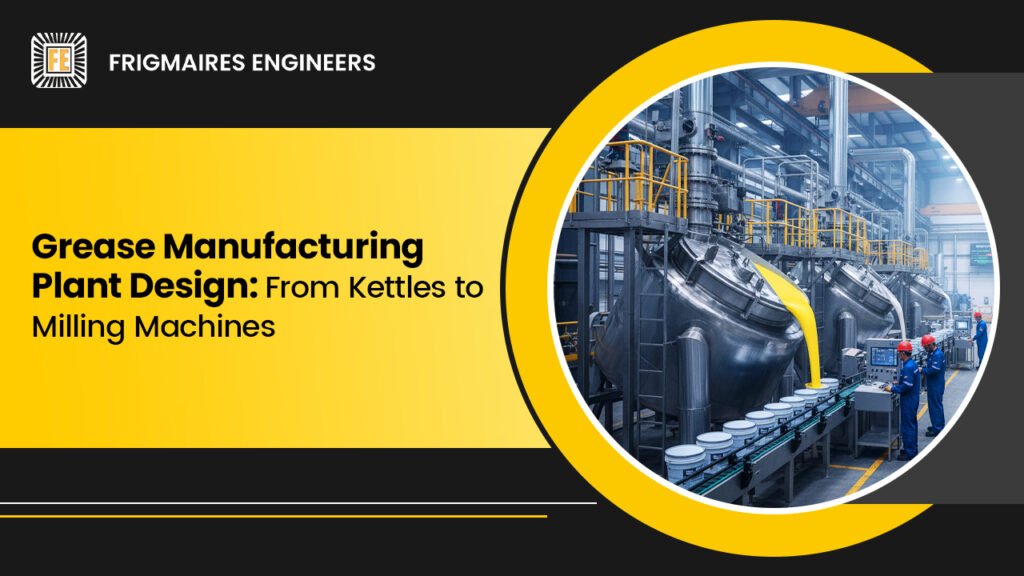
At the center of grease manufacturing is the reaction kettle, where the base oils and fatty acids react with alkali to form the soap.
Key design features of modern kettles include:
Jacketed vessels with steam or thermal oil heating for precise temperature control.
Agitators or anchor stirrers to ensure proper mixing during the saponification process.
Condensers and vents for vapor removal and pressure balancing.
Temperature and pressure sensors connected to the control system for automation and safety.
Depending on the grease type, the kettle may operate under atmospheric or vacuum conditions. For example, lithium-based greases require high temperatures (200–220°C) and controlled dehydration.
Modern plants use automated dosing systems for feeding fatty acids and alkalis, reducing manual handling and improving batch accuracy.
- Cooling and Finishing Operations
After saponification and dehydration, the hot grease mass is cooled down before further processing. Cooling may be achieved using heat exchangers or jacketed cooling vessels.
At this stage, base oil and performance additives are incorporated to fine-tune properties such as consistency and lubricity. Controlled cooling helps achieve the right fiber structure in the grease — an important determinant of its stability and shear strength.
- Milling and Homogenization
Once the grease base is prepared, it is passed through a milling machine or homogenizer to achieve uniform texture and dispersion of soap fibers.
Common equipment includes:
Colloid mills: For shearing and size reduction of thickener fibers.
Homogenizers: Provide high-pressure mixing to ensure uniform consistency.
Three-roll mills: Used for specialty greases requiring ultra-fine dispersion.
This step is crucial because it directly impacts the smoothness, stability, and performance of the final product. Poor homogenization can result in separation, uneven texture, or inconsistent quality.
- Filtration, Storage, and Packaging
After homogenization, the grease is filtered to remove impurities and transferred to storage tanks or packaging lines.
Modern packaging systems can handle a variety of formats — from small cartridges to large drums and pails. Filling machines are typically pneumatic or hydraulic, ensuring clean and efficient operations. Automation enables batch traceability by linking production data to each packaging unit.
- Automation and Control Systems
Today’s grease manufacturing plants are designed with a high degree of automation. PLC and SCADA systems integrate all critical processes — from raw material charging to final packaging.
Automation offers several benefits:
Accurate temperature and pressure monitoring.
Precise ingredient dosing and repeatable batches.
Reduced manpower and manual intervention.
Enhanced safety and product traceability.
Additionally, modern plants incorporate data logging systems, allowing operators to track batch parameters, production efficiency, and quality trends in real time.
- Environmental and Safety Considerations
Since grease manufacturing involves heating and chemical reactions, safety is a top priority. Plant designs must include:
Explosion-proof electrical systems in hazardous areas.
Ventilation and exhaust systems for fumes.
Firefighting systems and emergency shutdowns.
To meet sustainability goals, new-generation plants focus on energy-efficient heating systems, recycling condensates, and waste minimization.
- Frigmaires’ Expertise in Grease Plant Design
At Frigmaires Engineers, we specialize in turnkey solutions for grease manufacturing plants, from concept to commissioning. Our systems are tailored to produce a wide range of greases — including lithium, calcium, aluminum, and complex types — with complete automation and minimal manual handling.
Key offerings include:
Fully integrated reaction kettles and heating systems.
Colloid mills, homogenizers, and filtration units for superior finish.
Automated filling and packaging lines.
Custom PLC-based control systems for recipe management and data tracking.
Each plant is engineered for efficiency, scalability, and safety, ensuring clients achieve consistent quality and long-term reliability.
Conclusion
The design of a modern grease manufacturing plant combines chemical engineering precision with mechanical innovation. From the reaction kettle to the milling machine, every piece of equipment plays a vital role in determining product performance and consistency.
By adopting advanced automation, energy-efficient systems, and intelligent controls, manufacturers can achieve higher productivity, safer operations, and superior product quality.
With decades of expertise, Frigmaires Engineers continues to set the benchmark for innovation in grease plant design — helping industries around the world produce greases that perform under the most demanding conditions.